AWS Challange Day 01: Understanding AWS Pricing Models and Cloud Computing Options...

Introduction:
In the ever-evolving landscape of cloud computing, Amazon Web Services (AWS) stands out as a pioneer, offering a diverse range of services and pricing models. In this post, we will explore the various pricing models provided by AWS and delve into the distinctions between on-premises, on-cloud, and hybrid cloud computing models. Additionally, we'll unravel the layers of cloud services - Infrastructure as a Service (IaaS), Platform as a Service (PaaS), and Software as a Service (SaaS) - with practical examples. Finally, we'll take a brief journey through the history of AWS, highlighting key milestones and developments in its evolution.
AWS Pricing Models:
AWS provides flexible pricing models to cater to diverse user needs. The key models include:
On-Demand Instances:
AWS lets you use EC2 compute instances with on-demand pricing and pay by the hour or by the second. This pricing model enables you to spin up instances without paying for anything in advance. You can quickly terminate these instances as needed and pay for the resources you used. This option provides a high level of flexibility and scalability and is ideal for new AWS users testing the environment or for unpredictable workloads. However, on-demand instances are more expensive and can quickly accumulate costs.
Reserved Instances:
Reserved Instances (RIs) pricing offers significant discounts in return for committing to use AWS for a long period of time—1 or 3 years. AWS offers several ways to pay for RIs, including no upfront, partial upfront, and all upfront. It is relatively less complex to set up and maintain RIs, compared to spot instances. However, you are billed for all reserved instances, even if you do not use all capacity.
Spot Instances:
AWS Spot Instances can help you significantly reduce costs on computing capacity, because these instances are offered at up to 90% off the on-demand price. This model offers the largest potential cost-savings, especially when you need to scale quickly. However, spot instances can be challenging to use for some fault-sensitive workloads. A spot instance may be terminated at any time, whenever AWS needs this compute capacity. You get a two-minute warning before your instance is terminated.
Dedicated Hosts:
AWS lets you rent physical servers, which are called Dedicated Hosts. This option is considered highly secured and reliable, because you have the entire server for your private use. When renting a Dedicated Host, you do not need to do administrative tasks. AWS cleans and maintains the hardware. However, Dedicated Hosts are more expensive, and is mainly within the budget of enterprises.
Savings Plans:
Like RIs, AWS Saving Plans offer a significant discount in return for committing to use AWS resources for a longer period of time. However, Savings Plans let you make an hourly spend commitment, and then applies a discount rate, which is subtracted from your on-demand usage. Unlike RIs, Saving Plans are consolidated across resources, which means you can leverage several discounts across your AWS account.
On-Premises, On-Cloud, and Hybrid Cloud Computing:
- On-Premises computing:
Companies build and maintain physical infrastructure at their office or an outside hosting facility. With on premise computing, they have full control over the choice of hardware, connectivity, power supply, physical security, and many other aspects. This could soon become an overhead to manage.
Procuring physical locations in various geographic locations is expensive.
Building physical infrastructure is a time consuming process.
Planning, purchasing and deploying servers requires additional expertise and long term visibility on the utilization.
Maintaining redundant network connectivity and power supply to ensure high availability becomes complex.
Managing physical security and access control to prevent unauthorized access is challenging.
- Cloud computing:
Cloud providers take away the hardship of building physical infrastructure from their customers and provide benefits in multiple facets.
Most cloud providers offer their hardware services on a rental basis either as a subscription or pay-as-you-go model, reducing the TCO for their customers.
Companies do not need to worry about hardware purchase, maintenance and upgrades, as that is fully managed by the cloud provider.
Cloud providers often build massive infrastructure that is shared among their customers, reducing the infrastructure procurement time for customers.
Physical security, power, and network redundancy is fully managed by the cloud provider.
Cloud providers get discounted rates on the bulk procurement of hardware servers and networking components. A few cloud providers even build some of these components that are optimized for the cloud data center at a lower cost – the reduced rates often result in lower cost of operation for the customers.
Cloud providers like AWS offer completely managed, simplified solutions, removing the complexity for customers so that they can focus on building their products.
AWS also offers huge discounted rates to its customers when they commit to using AWS’s infrastructure for the long term.
AWS spreads out its costing to the lowest possible units, e.g. CPU-hours for compute, GB-month for storage and network – this gives a fine-grained control of cost to its customers.
AWS has built a global network of data centers called regions – each region has multiple redundant physically isolated availability zones, as well as edge locations in most popular cities across the world.
- Hybrid Cloud Computing:
Companies who have already invested in building physical infrastructures could benefit from leveraging the best of on premise and cloud capabilities. Cloud providers like AWS offer solutions that help customers connect their on-premises s\infrastructure with the AWS cloud, which allows them to share the capacity between AWS and on-premises infrastructure.
This hybrid cloud model allows organizations to:
Utilize the infrastructure capacity that they have already invested in.
Get lower latency to access the resources from on-premises servers if they are co-located within the company’s office.
Maintain complete privacy of data hosted on-premises – an added benefit for companies due to compliance or governance needs.
The hybrid cloud model brings added complexity to manage the network connectivity between cloud provider and on-premises data center. It also adds on-premises hosting responsibilities to the company.
IaaS, PaaS, And SaaS with Examples:
Infrastructure as a Service (IAAS), Platform as a Service (PAAS), and Software as a Service (SAAS) are three fundamental cloud service models.
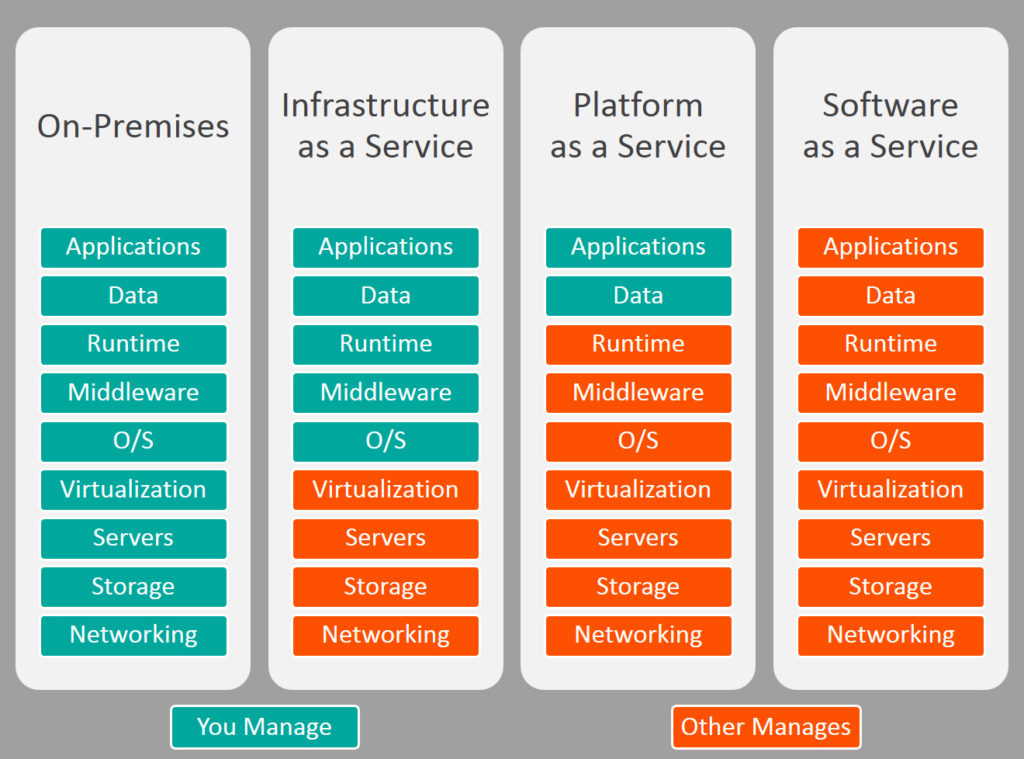
Infrastructure-As-A-Service:
Definition:
IaaS is the utilization of APIs to manage the lowest levels of network infrastructure, including networking, storage, servers, and virtualization.
Examples:
Rackspace, Digital Ocean, Google Compute Engine, and some deployments of Microsoft Azure and Amazon Web Services (AWS)
Common Use Cases:
IaaS is the most flexible service model for cloud computing, so it is especially effective for startups and organizations looking for agile scaling. It is also preferred by businesses that seek greater control over their resources.
Platform-As-A-Service: PaaS Examples And Definitions
Definition:
PaaS offers an even greater abstraction of cloud service, offering users the capability to build or deploy applications using tools (i.e. programming languages, libraries, services) without maintaining the underlying infrastructure. Users instead have control over the applications themselves.
Examples:
Salesforce, AWS Elastic Beanstalk, Heroku, Google App Engine (GAE), and OpenShift
Common Use Cases:
PaaS is highly available and highly scalable, and it gives organizations the ability to build and create new services and solutions without the need for highly skilled developers focused on software maintenance. PaaS is preferred by IT in hybrid cloud environments.
Software-As-A-Service: SaaS Examples And Definitions
Definition:
SaaS enables users to use and access the cloud provider’s applications that are running on the provider’s infrastructure from thin client or program interfaces.
Examples:
There are loads: Google G-Suite, Dropbox, Cisco Webex, Concur, Microsoft O365, Genesys, PayPal
Common Use Cases:
SaaS is a comfortable service model for applications that are highly interoperable – used by multiple users internally and externally – and for short-term projects. SaaS models are preferred by small and medium-sized businesses that do not wish to invest heavily in IT maintenance.
History Of AWS:
Amazon Web Services (AWS) has a rich history, marked by significant milestones and developments that have shaped the landscape of cloud computing. Here's a brief overview:
1. Launch of AWS (2006):
AWS was officially launched on March 14, 2006, with the goal of providing scalable and cost-effective cloud computing services.
The initial services included Simple Queue Service (SQS) and Elastic Compute Cloud (EC2).
2. Introduction of Amazon S3 (2006):
In the same year, Amazon Simple Storage Service (S3) was introduced, revolutionizing data storage in the cloud.
S3 allowed users to store and retrieve any amount of data at any time.
3. Global Expansion (2010):
AWS expanded its global presence by launching new regions, including one in Singapore.
Introduction of the Amazon Virtual Private Cloud (VPC) for enhanced networking capabilities.
4. AWS Marketplace (2012):
- AWS Marketplace was launched, providing a platform for customers to find, buy, and immediately start using a wide range of software applications and services.
5. AWS Certification Program (2013):
- AWS introduced its certification program, offering a way for IT professionals to validate their cloud knowledge and skills.
6. Expansion into China (2013):
- AWS expanded its footprint by launching its first region in China, catering to the growing demand for cloud services in the region.
7. AWS Lambda (2014):
AWS Lambda was introduced, marking a significant shift towards serverless computing.
Lambda allowed developers to run code without provisioning or managing servers.
8. Artificial Intelligence and Machine Learning (2017):
- AWS bolstered its AI and machine learning capabilities with services like Amazon SageMaker, providing tools for building, training, and deploying machine learning models.
9. AWS Outposts (2019):
- AWS Outposts was launched, enabling customers to run AWS infrastructure on-premises for a truly hybrid cloud experience.
10. COVID-19 Response (2020):
- During the COVID-19 pandemic, AWS played a crucial role in supporting organizations and governments by providing cloud services to enable remote work, enhance healthcare capabilities, and support research initiatives.
11. AWS Wavelength (2020):
- AWS Wavelength was introduced, bringing AWS services to the edge of the 5G network to reduce latency for applications that require ultra-low latency.
12. Sustainability Commitments (2020):
- AWS committed to achieving 100% renewable energy usage and announced plans to be carbon neutral by 2040.
13. AWS re:Invent (Annual Event):
- AWS re:Invent, an annual conference, became a platform for announcing new services, features, and partnerships, showcasing AWS's commitment to innovation.
The history of AWS is a testament to its continuous innovation and commitment to meeting the evolving needs of businesses and developers. From its humble beginnings with a few services to becoming a comprehensive and globally recognized cloud services provider, AWS has played a pivotal role in transforming the IT industry and shaping the future of cloud computing.
Conclusion: The AWS Journey
In just over a decade, AWS has transformed from a modest cloud platform to a global force in computing. With pioneering services, global expansion, and commitment to innovation, AWS has redefined cloud computing. Its evolution, marked by key milestones and a response to industry needs, showcases not only technological prowess but a commitment to sustainability and user empowerment. AWS remains a driving force, shaping the digital landscape and setting the standard for cloud services.


